
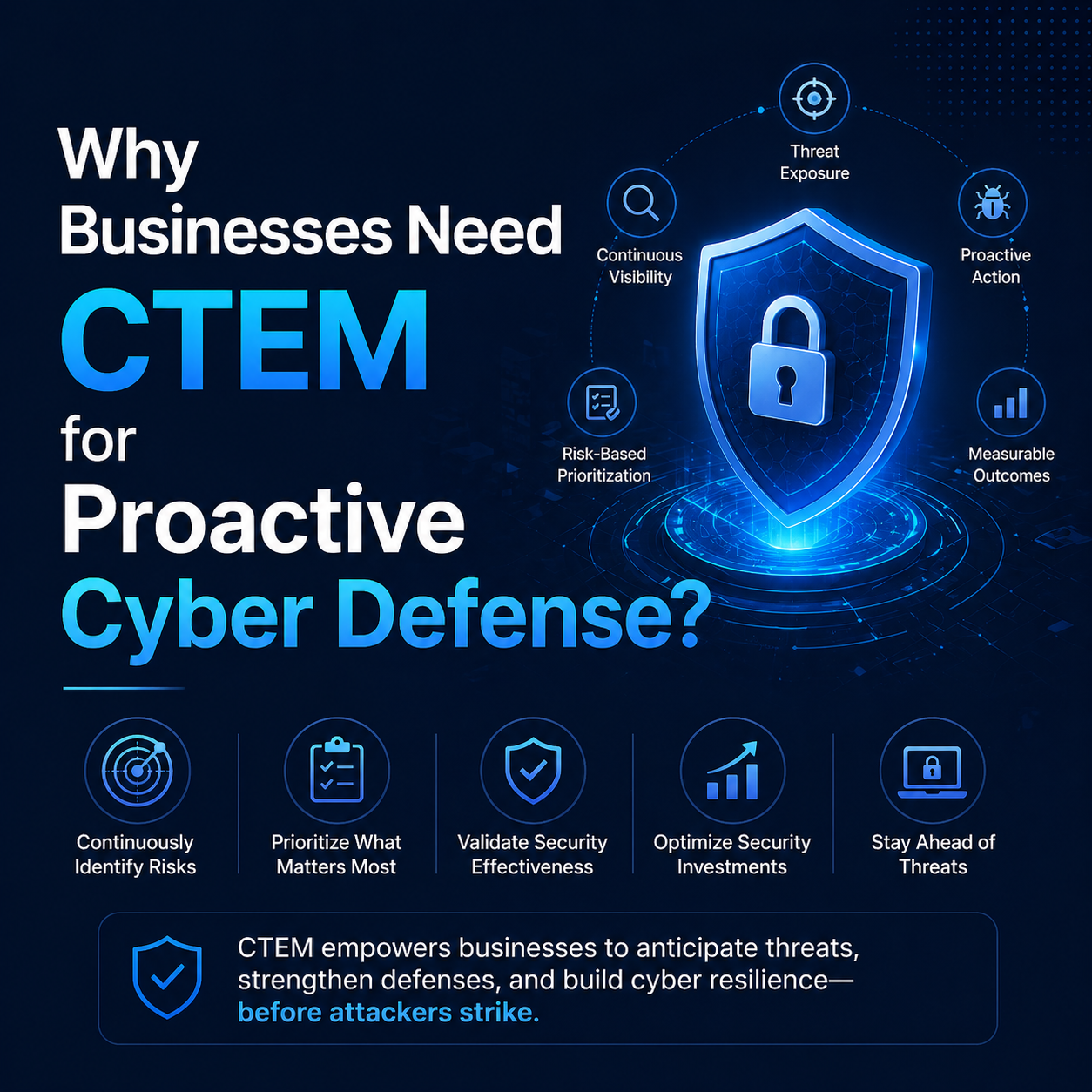
Why Businesses Need CTEM for Proactive Cyber Defense?
Cybersecurity attacks in the ever-evolving digital ecosystem have become an almost daily occurrence, rather than something that happens occasionally. Companies are becoming more digitized with the use of cloud technologies, remote workers, IoT systems, and connected systems, all increasing the entry points attackers can utilize to gain access into corporate networks.
With a conventional approach to cyber defense strategies, companies can no longer be dependent on reacting to breaches but rather should adopt a proactive model that is continuous in nature. CTEM is precisely such an approach.
Continuous Threat Exposure Management,( CTEM,).is the evolution from a reactive form of cybersecurity strategy to a proactive one.
Understanding CTEM
The Continuous Threat Exposure Management (CTEM) cybersecurity model seeks to continuously detect, assess, prioritize, and mitigate an organization’s exposure to cyberattacks. While typical security approaches revolve around periodic detection of cyberattacks, CTEM functions like an ongoing effort.
As opposed to the traditional approaches to security management, CTEM not only revolves around the discovery of vulnerabilities in an IT network. The model looks at all aspects of security including identity risk, cloud configuration, applications, and the infrastructure.
In this way, CTEM offers organizations the ability to see the picture from a broader perspective.
The Limitations of Traditional Cybersecurity
- Prior to discussing the need for CTEM, it is essential to discuss the limitations of the traditional approach in cybersecurity.
- Most companies leverage various security solutions like vulnerability scanners, endpoint detection technologies, and compliance checkers. While they are useful, they work independently from each other. As a consequence, users lack comprehensive visibility and have to deal with huge numbers of alerts.
- Security professionals have to tackle numerous vulnerabilities at once. However, most of them are not actually exploitable. Consequently, teams tend to spend too much time on addressing irrelevant risks.
- Another aspect related to the traditional method is its occasional nature. In other words, security scans do not run continuously, hence some vulnerabilities can be missed until the next check occurs.It becomes increasingly difficult to tackle emerging threats in today’s dynamic environment.
Why Businesses Need CTEM?
» Proactive Threat Identification
Another reason for companies to use CTEM is that it is proactive. It does not wait for a threat to strike; rather, it constantly looks out for any risks or vulnerabilities within the system.In this way, the business organization can prevent any attacks from taking place.
» Focus on Real Business Risk
However, not all vulnerabilities are created equal in terms of risk level. CTEM enables companies to evaluate their vulnerabilities according to exploitability, business impact, and attack vectors.
This way, businesses will only need to worry about the vulnerabilities that have the capability of compromising the system’s security.
» Visibility Without Interruption Through the Attack Surface
The current IT environment is one of perpetual transformation, where assets can be constantly created, modified, or removed. CTEM provides non-stop visibility through the entire attack surface, starting from the cloud infrastructure to endpoint, application, and identity components.
» Improved Decision-Making and Prioritization
CTEM is capable of solving the issue faced by security teams that arise due to the sheer quantity of alerting messages caused by decision fatigue. CTEM can solve this problem because it correlates different sources of information and provides a prioritized output for easier decision-making.
» Reduction in Breach Risk
By constantly detecting and fixing any exploitable weaknesses, CTEM greatly decreases the chances of cyber attacks occurring.
Studies have found that there is actually a limited number of vulnerabilities that could result in cyber attacks. CTEM enables an organization to detect and fix those key weaknesses.
» Security & Business Objectives Alignment
CTEM makes it easier for organizations to connect cybersecurity vulnerabilities with their risks, making it easier for the management to understand these risks.
Through such an alignment, there is effective communication between the security and executive teams, which means that cybersecurity decisions will be in line with the business objectives.
» Improved Collaboration Among Departments
Cybersecurity cannot be the responsibility of only one department; rather, it takes the joint effort of many individuals who work for IT, cloud engineering, software development, and cybersecurity.
The Five Stages of CTEM
A successful CTEM program typically follows a structured lifecycle consisting of five stages:
- Scoping – At this stage, organizations get to determine what their most important assets, processes, and systems are. This allows for focusing security measures only in the most impactful areas of an organization’s operations.
- Discovery – Vulnerabilities, configuration problems, and exposures are found at this stage, giving organizations insight into the entire attack surface.
- Prioritization – Every risk does not need addressing immediately. Prioritizing risks in CTEM is done by considering severity, exploitability, and impact.
- Validation – Validation will help ensure that the vulnerabilities detected are actual and exploitable. This process helps to eliminate any false positives in the detection process.
- Mobilization (Remediation) – The last phase involves the remediation of the detected vulnerabilities.
CTEM as a Strategic Advantage
Besides providing increased security in an organization, CTEM is an added advantage for companies. Companies that have adopted CTEM are able to deal with risks faster compared to previously when they had not adopted CTEM. Furthermore, CTEM helps organizations to maximize their security capabilities.
This is achieved through identifying weaknesses and strengths in the security capabilities.
Challenges in the Implementation of CTEM
Even though CTEM offers many strengths, its application is not always simple. The problems that arise from it include:
- Tools fragmentation: Many security tools operate independently
- Lack of an owner: Not knowing who is supposed to remedy the situation
- Resource constraints: Lack of sufficient knowledge and workforce
Necessity of continuous supervision
Most firms opt to go for managed CTEM services because of these difficulties.
Conclusion
In an era where cyber threats are constantly evolving, businesses can no longer rely on reactive security measures. Continuous Threat Exposure Management (CTEM) provides a proactive, structured, and continuous approach to cybersecurity that aligns with modern business needs.
By focusing on real risks, improving visibility, and enabling faster remediation, CTEM empowers organizations to stay ahead of attackers and protect their critical assets effectively.
Adopting CTEM is not just a technological upgrade—it is a strategic shift toward a more resilient and proactive cybersecurity posture. Businesses that embrace this approach are better equipped to navigate the complexities of today’s threat landscape and ensure long-term success.