

How AI is Changing the Future of the Oil and Gas Industry?
With a GDP of over $70 trillion making up for almost 5% of the global economy, Oil & Gas Sector is incontrovertibly one of the most significant ones in the world.
But in past few years, the sector has seen huge losses, which have indirectly affected the world’s economy and job industry as well. Stats say that since 2012, Organization of Petroleum Exporting Countries (OPEC) members have seen a fall in revenue of over $750 billion. Consequently, some of the biggest Exploration and Production (E&P) companies like Shell, Aramco and Schlumberger have cut costs on various fronts to soak up the losses, resulting in thousands of professionals losing their jobs.
But then recovering from these losses is not the only challenge Oil & Gas industry faces; improving its performance with smart investment decisions, while working synergically in the best interests of our ecosystem, is the real challenge here.
This calls for something that can integrate the elements of Oil & Gas Industry. Something that can utilize the enormous data present in the industry to prepare a more feasible, future-proof approach. In simpler words, we need AI in the sector.
Full-fledged application of AI in Oil & Gas sector could be game-changing. Evidently, some of the biggest industries like ExxonMobil, Royal Dutch Shell, Sinopec and more have already adopted AI in pursuit of churning out better results. So how exactly is AI helping in E&P companies? Let’s find out:
-
Stock management
Exchange of information among facility, wells and reservoirs is very important to maintain a surplus. AI can link these three components so that an optimum level of production can always be maintained. Apart from that, reservoir modelling, site survey for reservoir construction and much more can be greased up with the use of Digital Oil Field (DOF) technology.
-
AI in Exploration and Production
AI can utilize the concepts of geoscience for planning and execution of drilling. And as it considers several scientific factors involved in the drilling process, it eliminates the possibility of operational failures up to a large extent. With time, Machine Learning software integrated with AI can help optimize the process by analysing patterns and frequency of drilling.
-
Prediction and Forecast
Application of AI in predicting the production and exploration opportunities is good for not only the Oil & Gas sector, but also for the global markets. Analysing the exploration patterns to define the production strategy would be a smart move as it increases efficiency and productivity; and at the same time, lets investors come up with informed decisions.
-
Automated Inspections
Use of drones for surveying new sites for drilling, maintenance of equipment, and diffusing potential hazards has always been around in Oil & Gas technology. This would not only make the surveys quick; it would save large sums of money needed for carrying out these inspections. Besides, the data acquired from the surveys can be analysed and processed to identify spots with frequent failures and infrastructural faults like roads and oil-supply lines.
Artificial Intelligence (AI) has moved beyond the “hype” phase to become a foundational element of modern energy strategy. It isn’t just about robots on oil rigs; it’s about a fundamental shift in how we discover, extract, and refine energy. As we move through 2026, AI is turning Big Oil into “Big Tech,” making operations safer, cleaner, and dramatically more efficient.
Here is how AI is changing the future of the Oil and Gas industry right now.
1. Upstream: The End of “Guesswork” in Exploration
The most expensive mistake in the energy sector is drilling a dry well. Traditionally, geoscientists spent months analyzing seismic surveys to find potential reservoirs. AI has compressed this timeline from months to days.
-
Seismic Interpretation: Machine learning algorithms can process terabytes of subsurface data to identify fault lines and oil traps with a precision that human eyes often miss.
-
Precision Drilling: Modern drilling rigs are equipped with smart sensors that feed data into AI models. These models adjust drilling speed and pressure in real-time, navigating through rock formations with surgical accuracy to avoid hazards.
The Impact: Companies are seeing a massive reduction in exploration costs and a higher success rate in hitting viable reservoirs.
2. Midstream: The Era of the “Self-Healing” Supply Chain
Moving oil and gas through thousands of miles of pipelines has always been a logistical nightmare. AI is transforming midstream operations from reactive to predictive.
-
Predictive Maintenance: This is perhaps the biggest ROI generator. Instead of fixing a pump when it breaks (causing costly downtime), AI analyzes vibration, heat, and sound data to predict failure weeks in advance. Maintenance becomes a scheduled pit stop rather than an emergency shutdown.
-
Smart Pipeline Monitoring: Drones equipped with computer vision fly over pipelines to detect minute leaks, corrosion, or even security threats. AI analyzes the video feed instantly, flagging anomalies that a human inspector might miss due to fatigue.
3. Downstream: Refining at the Speed of Market
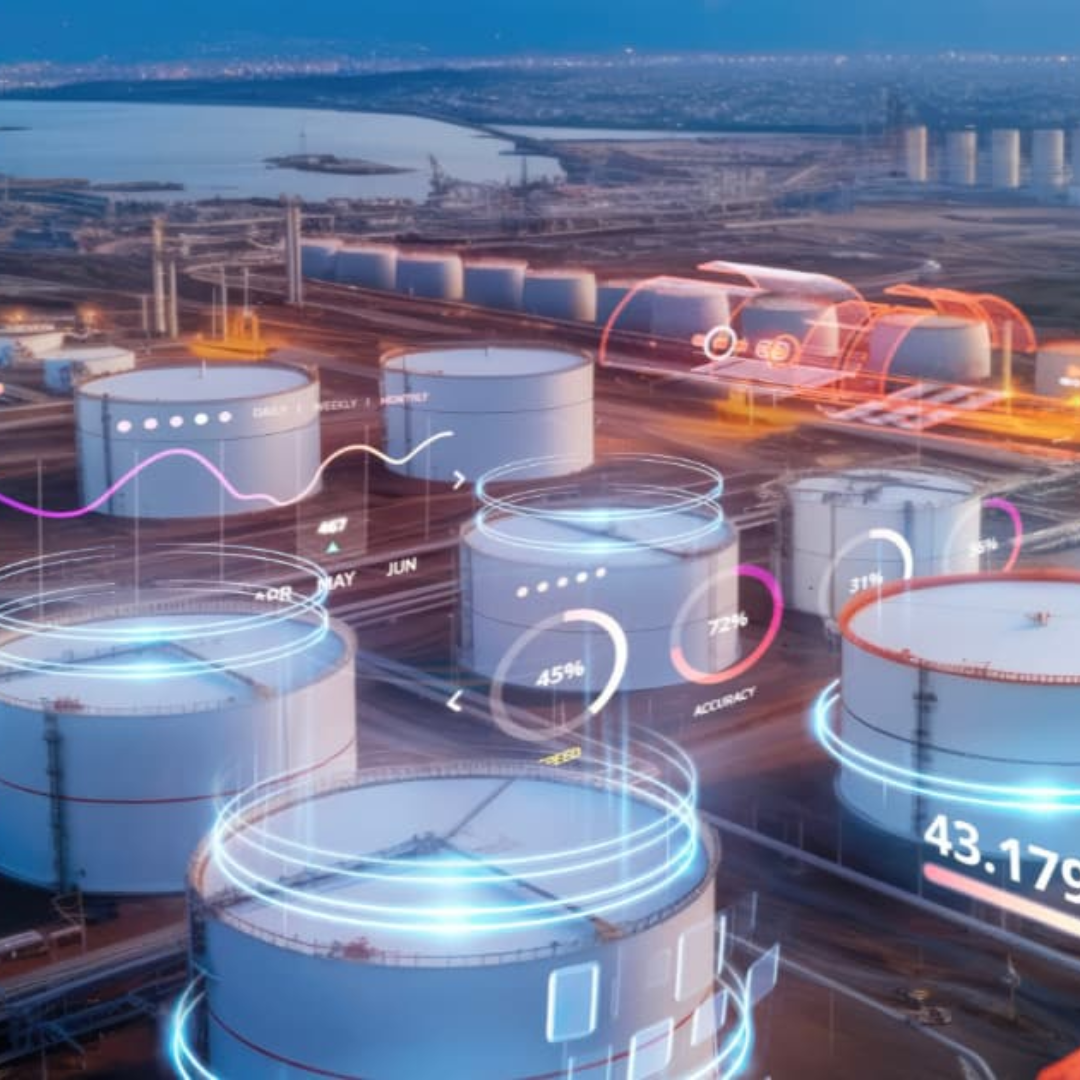
Refineries are complex beasts, but AI is taming them by creating “Digital Twins”—virtual replicas of the entire facility.
-
Digital Twins: Operators can simulate changes in a virtual environment before applying them to the real plant. This allows them to test how a specific blend of crude oil will react to different temperatures without risking safety or product quality.
-
Market-Driven Production: AI algorithms analyze global market trends, weather patterns, and geopolitical news to predict demand. Refineries can then automatically adjust their output mix (e.g., producing more jet fuel vs. diesel) to maximize profitability in real-time.
4. The Green Shift: AI as a Sustainability Tool
Surprisingly, AI is one of the biggest allies in the industry’s push toward “Net Zero.”
-
Methane Leak Detection: Satellites and ground sensors use AI to pinpoint methane leaks instantly. Since methane is a potent greenhouse gas, fixing these leaks quickly significantly lowers the industry’s carbon footprint.
-
Carbon Capture Optimization: AI is being used to design more efficient materials for Carbon Capture, Utilization, and Storage (CCUS), helping companies trap CO2 more effectively than ever before.
5. The Future: Generative AI and the “Connected Worker”
Looking ahead to 2026 and beyond, Generative AI (like the technology behind ChatGPT) is entering the field. Imagine a field technician repairing a complex valve on a remote offshore rig.
Instead of flipping through a 500-page manual, they can ask a voice-activated AI assistant, “How do I recalibrate the pressure sensor on Unit 4?” and receive step-by-step guidance instantly. This “Digital Mentor” capability is bridging the skills gap and making the workplace safer.
Summary: The New Energy Landscape
| Feature | Traditional O&G | AI-Enabled O&G |
| Exploration | Manual seismic analysis (Months) | AI seismic interpretation (Days) |
| Maintenance | Reactive (Fix when broken) | Predictive (Fix before it breaks) |
| Safety | Manual inspections | Automated drone/sensor monitoring |
| Decision Making | Siloed data & gut feeling | Real-time, data-driven insights |
The oil and gas industry has long been defined by heavy machinery, complex supply chains, and high-risk operations. Traditionally driven by geology, engineering expertise, and experience-based decision-making, the sector is now undergoing a quiet but powerful transformation. Artificial Intelligence (AI) is reshaping how energy companies explore, extract, transport, and refine resources—moving the industry from crude operations to code-driven intelligence.
This digital shift is not about replacing humans but empowering them with smarter tools, faster insights, and safer operations.

The Need for Transformation in Oil and Gas
Oil and gas companies face growing pressure from multiple fronts: volatile commodity prices, rising operational costs, safety concerns, environmental regulations, and the global push toward sustainability. Margins are tightening, and inefficiencies that were once tolerated are no longer acceptable.
AI has emerged as a critical enabler to tackle these challenges by turning massive volumes of operational data into actionable intelligence—something the industry has historically struggled to do at scale.
AI in Exploration: Smarter Decisions Beneath the Surface
Exploration is one of the most expensive and risky stages in the oil and gas lifecycle. Seismic surveys generate enormous datasets, often taking months for interpretation. AI-powered machine learning models can analyze seismic data far more quickly and accurately than traditional methods.
By identifying patterns in subsurface data, AI helps geologists:
- Improve reservoir identification
- Reduce dry well drilling
- Optimize drilling locations
- Increase success rates while lowering exploration costs
What once took teams months can now be achieved in days, significantly improving decision confidence.
Predictive Maintenance: Preventing Failures Before They Happen
Unplanned equipment failures can cost oil and gas companies millions of dollars per hour, not to mention the safety risks involved. AI-driven predictive maintenance uses sensor data, historical performance records, and real-time monitoring to predict when equipment is likely to fail.
AI systems can:
- Detect early signs of wear and tear
- Recommend maintenance schedules
- Reduce downtime and repair costs
- Extend the lifespan of critical assets
This shift from reactive to predictive maintenance is one of the most tangible ways AI delivers immediate ROI in the industry.
Enhancing Safety Through Intelligent Monitoring
Oil and gas operations are inherently hazardous. AI-powered computer vision and analytics are now being used to monitor worksites in real time.
These systems can:
- Detect unsafe worker behavior
- Monitor compliance with safety protocols
- Identify leaks, spills, or abnormal conditions
- Trigger instant alerts to prevent accidents
By reducing human error and improving situational awareness, AI is helping create safer environments for workers across upstream, midstream, and downstream operations.
Optimizing Production and Operations
AI enables continuous optimization of production processes by analyzing variables such as pressure, temperature, flow rates, and energy consumption. Machine learning models adjust operations in real time to maximize output while minimizing waste.
Key benefits include:
- Improved production efficiency
- Reduced energy consumption
- Lower emissions
- Better resource utilization
AI-driven optimization ensures operations run at peak performance even under fluctuating conditions.
Supply Chain and Logistics Intelligence
From crude transportation to refinery scheduling, oil and gas supply chains are complex and global. AI brings visibility and intelligence to these networks by forecasting demand, optimizing routes, and managing inventory.
AI helps companies:
- Reduce transportation delays
- Minimize storage costs
- Improve demand forecasting
- Respond faster to disruptions
This level of agility is critical in a market where timing directly impacts profitability.

Supporting Sustainability and Emission Reduction
As the world transitions toward cleaner energy, oil and gas companies are under increasing scrutiny to reduce their environmental impact. AI supports sustainability initiatives by tracking emissions, optimizing energy usage, and identifying inefficiencies that contribute to waste.
AI-driven insights help organizations:
- Monitor carbon footprints accurately
- Optimize fuel consumption
- Support ESG reporting
- Align with regulatory requirements
Technology is becoming a bridge between operational efficiency and environmental responsibility.
The Human Role in an AI-Driven Industry
Despite fears of automation, AI in oil and gas is not about replacing skilled professionals. Instead, it augments human expertise by eliminating repetitive tasks and enabling data-driven decision-making.
Engineers, geologists, and operators are now empowered to focus on strategy, innovation, and problem-solving—supported by intelligent systems that enhance accuracy and speed.
Looking Ahead: The Future Is Hybrid
The future of oil and gas will be shaped by a hybrid model where human expertise and AI intelligence work together. Companies that embrace AI early are already seeing improvements in safety, efficiency, cost control, and sustainability.
Those that delay risk falling behind in an industry that is rapidly becoming digital at its core.

Conclusion
From seismic exploration to refinery optimization, AI is rewiring every layer of the oil and gas value chain. What was once an industry dominated by physical assets is now becoming a data-driven ecosystem where intelligence fuels performance.
The journey from crude to code is not just a technological upgrade—it is a strategic evolution. And for oil and gas companies willing to adapt, AI is proving to be one of the most powerful tools shaping their future.