
Predictive Analytics Solutions vs Machine Learning: Key Differences
Business leaders are often caught in a tug-of-war between two big ideas: should they invest in Predictive Analytics Solutions or go all-in on machine learning development? The tech industry loves to treat these terms like synonyms, but that’s a mistake that costs money. One is about using math to find a clear answer to a specific question. The other is about building a system that learns to think for itself.
Deciding between them isn’t just a technical choice. It’s a strategy for how you’ll use your data for years to come. If you pick the wrong one, you end up with a tool that either can’t keep up with your growth or is so complex that your team can’t explain why it’s making certain calls.
Predicitve Analytics VS Machine Learning: What Are You Actually Trying to Do?
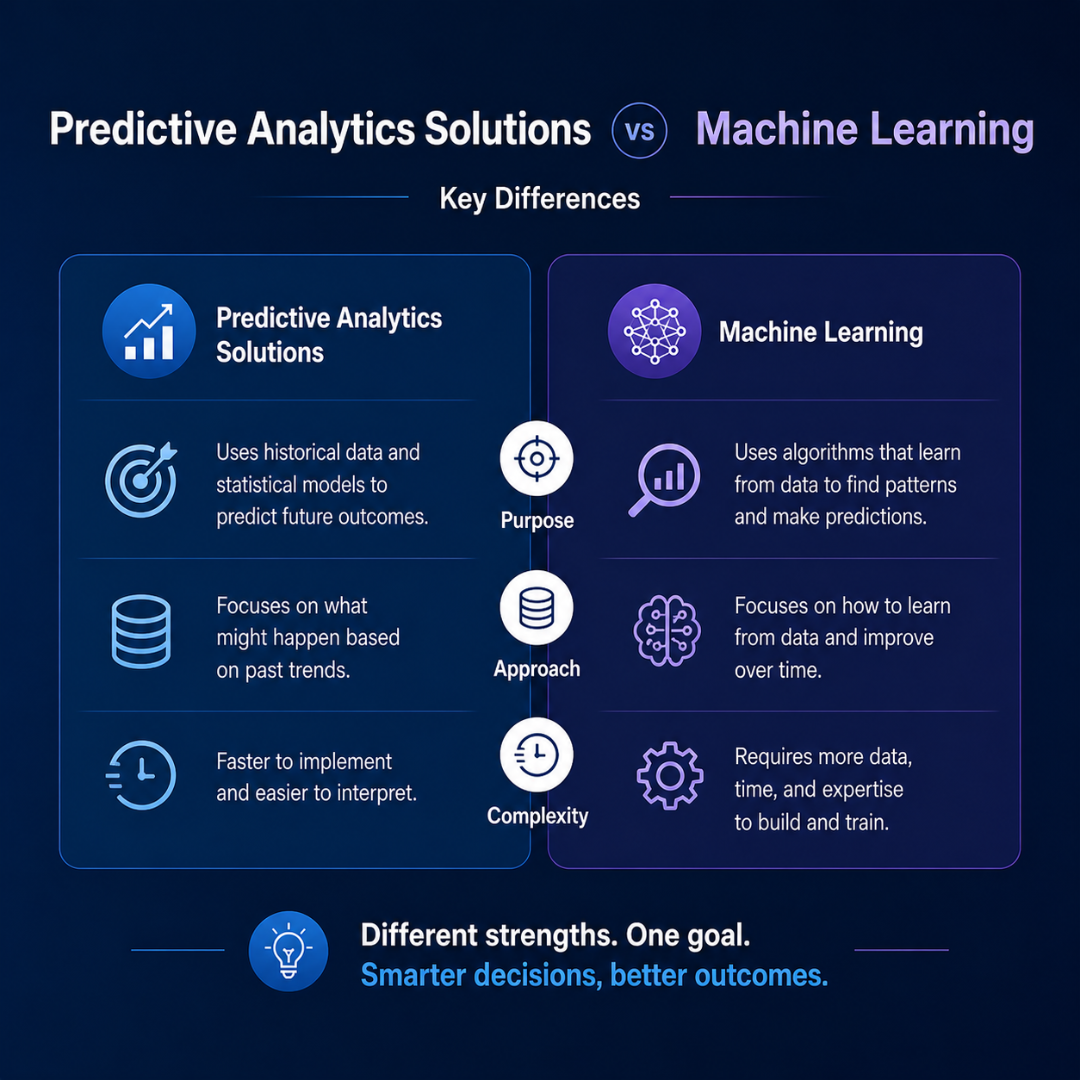
Predictive Analytics Solutions focus on foresight. You have a pile of historical data, and you want to know what happens next. Think of it like looking at past holiday sales to guess how many sweaters you’ll sell this December. It uses statistics to give you a specific number or a probability.
Machine learning development is a broader beast. It’s a part of AI where you give a computer an algorithm and let it find patterns without you telling it exactly what to look for. While predictive analytics tells you “what,” machine learning is often busy figuring out the “how” and “why” on a much larger scale.
Predictive Analytics Solutions: The Reliability Play
If your business has a stable environment, Predictive Analytics Solutions Development is usually your best bet. It works wonders when the future looks a lot like the past. For instance, a bank predicting whether a person will pay back a loan uses historical credit scores. This is a focused business question.
The benefits here are clear:
- Quicker to assemble: You do not require a huge collection of GPUs to execute these models.
- High transparency: When a regulator inquires why a customer was refused credit, you have a formula that is transparent enough to demonstrate to him or her.
- Less expensive: It is common to have these running with tools your staff is familiar with, such as SQL or even advanced Excel.
| Feature | Predictive Analytics Solutions |
| Main Tool | Statistics |
| Human Input | High (Manual updates) |
| Transparency | Clear and open |
| Data Type | Structured (Tables) |
Yet, these models are brittle. If the market shifts like a global pandemic or a sudden change in consumer habits, the model won’t know. It stays the same until a human analyst steps in to retrain it.
Machine Learning Development: The Scalability Play
Machine learning development is for when things get messy. If you’re dealing with thousands of products, millions of customers, or data that isn’t just numbers in a table, statistics aren’t enough.
The main features of machine learning:
- It works with unstructured data: Images, text, and voice recordings are not represented in a spreadsheet, yet they can be processed by ML.
- It is independent: With the pipeline in place the system is able to update its own logic as new information is received.
- It identifies abnormalities: This is what your bank applies ML to detect fraud. It is able to detect a suspicious transaction within milliseconds by contrasting with your entire history.
Key Differences: Intent, Scope, and Autonomy
The most effective way to distinguish these two is to look at how they function within a business environment.
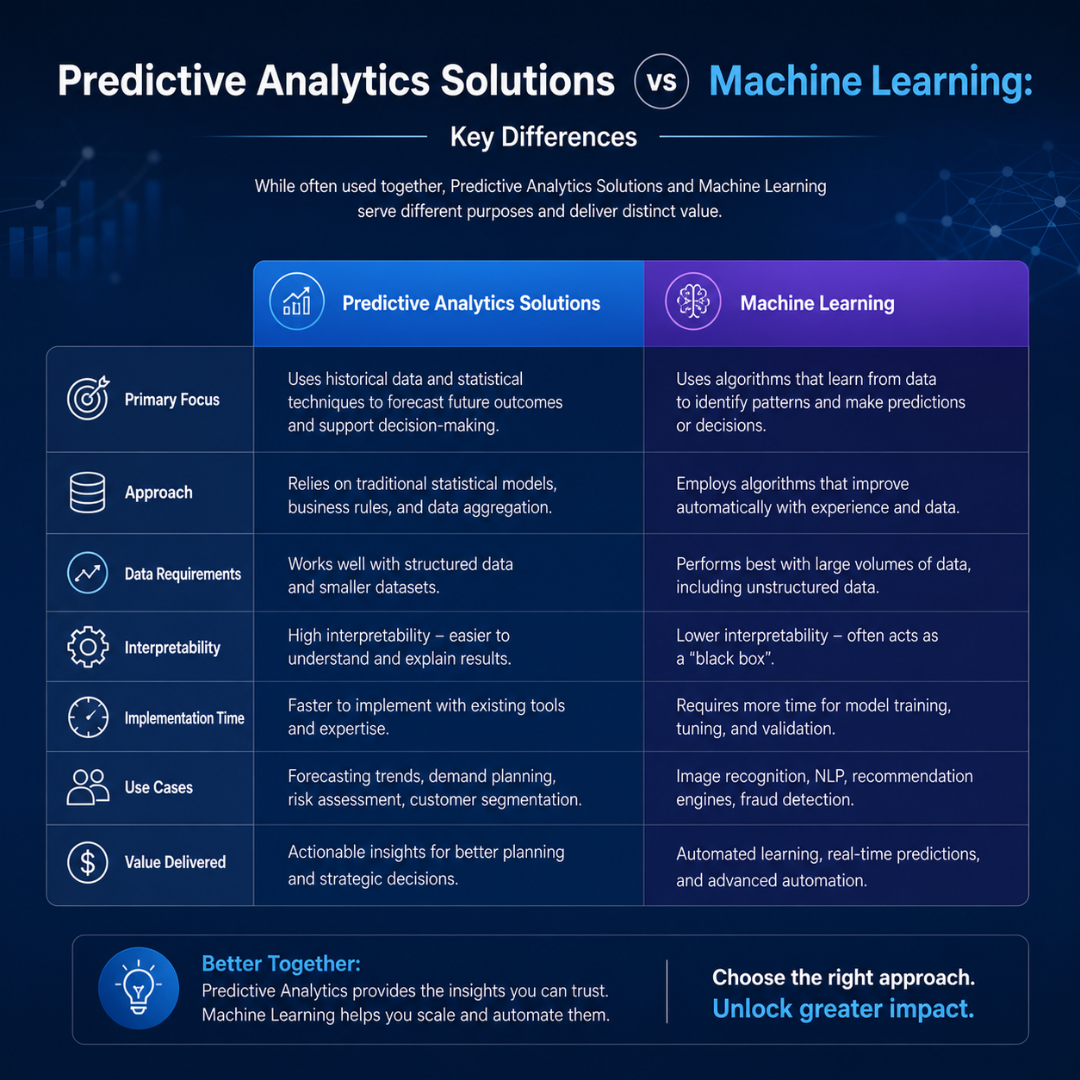
| Feature | Predictive Analytics | Machine Learning |
| Primary Goal | Forecasting specific future outcomes. | Developing self-learning algorithms. |
| Output | Reports, scores, and probabilities. | Automated actions and pattern recognition. |
| Human Role | Humans interpret data to make decisions. | Systems often act or adjust automatically. |
| Data Usage | Relies heavily on historical structured data. | Handles massive volumes of unstructured data. |
1. The Question of “Why” vs. “What”
Predictive analytics is often prescriptive. It identifies a trend and allows a manager to intervene. For example, Predictive Analytics in FinTech helps lenders determine the probability of a default. The “solution” is the insight itself.
Machine learning, by contrast, focuses on the “how.” It creates the underlying engine that enables that prediction. An ML model might analyze thousands of variables in real-time to adjust a credit score instantly, learning from every new transaction it processes.
2. Static Models vs. Dynamic Evolution
Standard Predictive Analytics Solutions often use static models. A data scientist builds a model based on last year’s sales data. That model stays the same until a human updates it.
Machine learning is dynamic. It is built to evolve. If customer behavior shifts suddenly, due to a global event or a new competitor, an ML model can recognize the shift in the data stream and adjust its internal logic automatically.
Why Business Owners Need Predictive Analytics Solutions Development?
Most small to medium-sized enterprises (SMEs) find their highest ROI in Predictive Analytics Solutions Development. Here is why:
» Clarity in Decision Making
Predictive models convert the gut feelings to data-based strategies. When you have a 75% likelihood of a certain line of product experiencing a demand spike in October, then you can optimize your supply chain in August. This reduces waste and maximizes capital efficiency.
» Customer Retention
It is expensive to attract new customers compared to the existing ones. By tracking the signs of the so-called at-risk behaviors, e.g., a decrease in the frequency of logins or a change in buying habits, your team can send out individualized offers before the customer goes away.
» Risk Management
Predictive solutions can flag fraudulent transactions or identify patients at risk of readmission. These insights save money and, in some cases, lives.
When to Invest in Machine Learning Development?
If predictive analytics is about foresight, machine learning development is about automation and scale. You should consider ML when:
- You deal with “Big Data”: If your data sets are so massive that a human could never manually identify patterns, you need an ML engine.
- You require real-time responses: HFT or real-time ad bidding requires systems with milliseconds response times.
You need to personalize at scale: If you have millions of users and want to display each user a unique homepage (such as Netflix or Amazon), then you can only do it with ML.
Machine Learning & Predictive Analytics: How They Work Together
It is a mistake to view these as competing technologies. In reality, they form a hierarchy. Machine learning provides the computational muscle that makes modern predictive analytics possible.
A company might start with basic data reporting. As they grow, they move into Predictive Analytics Solutions to start looking forward. Eventually, they integrate machine learning development to automate those predictions and scale their operations across global markets.
Implementation Hurdles: What to Watch For
Implementing these technologies is not as simple as buying a piece of software. It requires a cultural shift toward data literacy.
» Data Quality
Neither a predictive model nor an ML algorithm can fix bad data. If your records are fragmented, duplicated, or biased, your results will be flawed. Clean, centralized data is the prerequisite for success.
» The “Black Box” Problem
One challenge with complex ML models is explainability. If an algorithm denies a loan, you need to be able to explain why. Certain predictive solutions are more transparent, providing a clear path from data point to conclusion, which is often required for regulatory compliance.
» Talent Acquisition
Finding the right experts for Predictive Analytics Solutions Development is different from hiring for ML research. You need people who understand your specific business logic just as much as they understand the math.
Real Impact: ROI and the Bottom Line
Why does any of this matter? Because the ROI is real if you pick the right tool for the job. Companies that use these tools well see massive shifts in their margins.
- Inventory: Using Predictive Analytics Solutions for demand forecasting can drop inventory costs by 20% to 50%.
- Customer Loyalty: Catching “churn” signals early can boost profits by up to 95% if you keep just 5% more customers.
- Efficiency: Automating risk analysis with ML can cut the time your team spends on manual reviews by half.
But there’s a trap. About 85% of machine learning projects fail. Most of the time, it’s because the business didn’t have a clear goal or tried to use “cool” tech on a problem that just needed a simple spreadsheet.
Avoiding the “Technical Debt” Trap
In software, technical debt is like a high-interest credit card. You take a shortcut today, and you pay for it with more work later. In machine learning development, this debt is even heavier.
It manifests itself in pipeline jungles where your data is bound together by sloppy code that no one is familiar with. It is also reflected in the dead metadata which occurs when the system is relying on old rules to base decisions on.
In order to prevent this, you must have a partner who realizes that making the model is not the 100% of the work. The remainder is the plumbing that makes it operate.
Practical Applications Across Industries
To see the value, look at how these tools operate in the real world.
» Retail and E-commerce
Predictive models forecast seasonal demand, helping retailers stock the right sizes and colors. ML engines power the recommendation sliders (“You might also like…”) that drive up average order value.
» Manufacturing
Predictive maintenance is a huge cost-saver. By analyzing sensor data from machinery, companies can predict a part failure before it happens. ML goes a step further by optimizing the entire assembly line flow in real-time to reduce energy consumption.
» Healthcare
Predictive analytics identifies populations at risk for chronic diseases. ML helps in diagnostic imaging, spotting anomalies in X-rays or MRIs that the human eye might miss.
Choosing Your Path: A Strategic Roadmap
How do you decide where to put your budget? Ask yourself these three questions:
- Do I need a forecast or an action?
If you need a forecast to help you decide, go with predictive analytics. If you need the system to take the action for you, look at machine learning.
- Is my data structured or unstructured?
Spreadsheets and databases are perfect for predictive solutions. Video, audio, and massive social media streams usually require ML.
- What is the cost of an error?
If an automated mistake is catastrophic, start with predictive analytics where human oversight is the final step.
Planning for 2026 and Beyond
The landscape is changing. We’re moving toward something called “Agentic AI”. These aren’t just tools that give you a chart; they are agents that take action. Imagine a system that doesn’t just predict you’ll run out of stock but actually contacts the vendor and negotiates a price for more.
Another shift is “Edge Computing.” Instead of sending all your data to a central cloud, models will run on local devices like a camera in a warehouse or a sensor on a truck. This makes everything faster and keeps your data more secure.
Making the Choice: A Simple Framework
If you’re still on the fence, ask yourself these three questions:
- How clean is your data? If it’s mostly numbers in a database, go with Predictive Analytics Solutions. If it’s messy, like emails or photos, you need ML.
- Does the answer need to be explained? If a board member or a lawyer needs to know why a decision was made, stick with statistics.
- What’s your budget for maintenance? If you want to “set it and forget it,” avoid ML. If you can invest in a team to keep the system sharp, ML will give you a bigger edge.
As a business owner, you don’t need to be a math expert, but you do need to know which tool fits your goal. Predictive Analytics Solutions offer clarity and a fast ROI. Machine learning development offers scale and the chance to outrun your competition with automation.
Often, the smartest move is to start with the simpler statistical approach. Get a win. See the ROI. Then, use those gains to build the more advanced machine learning systems that can take your business to the next level.
If you’re looking to turn your data into a real asset, let’s talk about which path makes sense for your specific goals.